
Civil Construction Companies in Pakistan: What to Look for in a Reliable Contractor
A highway that deteriorates shortly after completion, a drainage network that cannot handle seasonal rainfall, or a water supply system that requires repeated repairs can create financial and operational problems for years. These challenges demonstrate why selecting the right civil engineering contractor is essential for infrastructure development.
For government departments, private developers, industrial organisations, and infrastructure investors, comparing civil construction companies in Pakistan involves much more than reviewing construction prices. The contractor must understand technical specifications, manage specialised resources, coordinate engineering activities, and deliver infrastructure designed for long-term performance.
Pakistan’s infrastructure needs extend across transportation, urban development, industrial estates, housing communities, and public utility networks. Each project presents different engineering challenges, requiring contractors with relevant capabilities and a structured approach to execution.
This guide examines seven essential checks for evaluating civil construction contractors in Pakistan, with particular attention to infrastructure expertise, project delivery systems, and evidence of technical performance.
What Do Civil Construction Companies in Pakistan Actually Do?
Civil construction focuses on developing the physical infrastructure that supports transportation, utilities, public services, and economic activity.
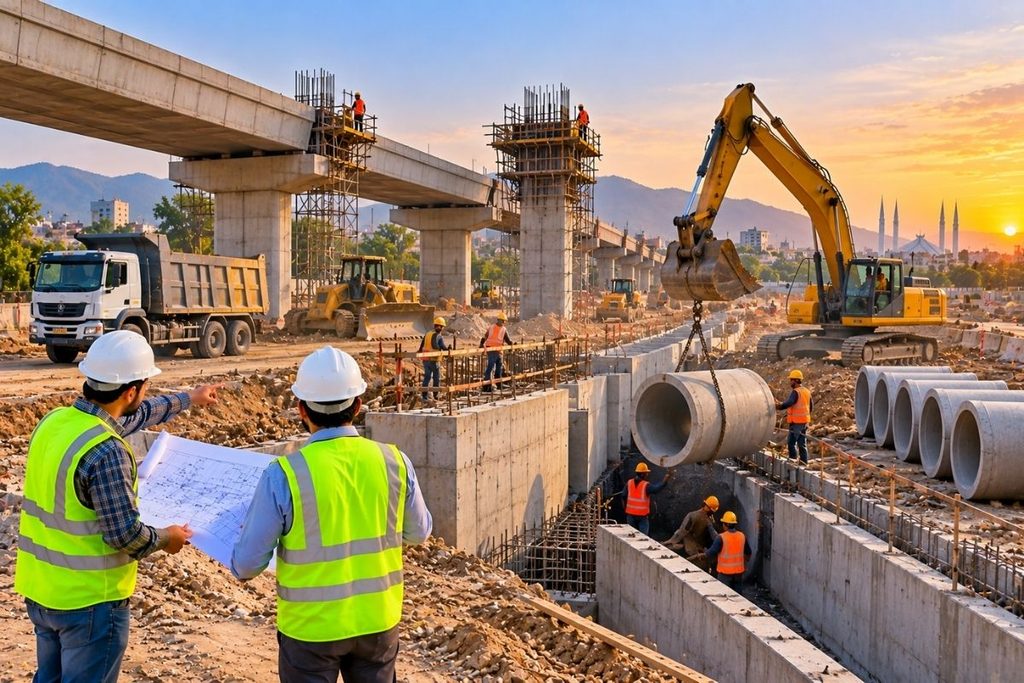
Unlike projects concerned primarily with constructing individual buildings, civil engineering works frequently involve extensive ground preparation, underground networks, large construction areas, and connections to existing infrastructure.
Typical civil construction activities include:
- Highway and road development.
- Road widening and pavement rehabilitation.
- Earthworks and embankment construction.
- Stormwater drainage infrastructure.
- Sewerage collection networks.
- Water supply pipelines and distribution systems.
- Pedestrian underpasses and related structures.
- External infrastructure for housing and commercial developments.
- Industrial site preparation and utility installations.
These activities are often interdependent.
For example, a road development project may require underground utilities and drainage structures to be completed before pavement layers can be constructed. If the work is poorly sequenced, newly completed surfaces may need to be excavated again to install missing services.
Reliable civil construction companies must therefore coordinate multiple engineering disciplines while maintaining consistency across project stages.
1. Look for Evidence of Infrastructure Delivery at a Comparable Scale
One of the strongest indicators of a contractor’s suitability is experience delivering infrastructure of similar complexity.
A company that has completed small access roads may not automatically possess the resources required for a major urban road network. Similarly, experience installing short drainage connections does not necessarily demonstrate the capacity to construct an extensive sewerage system.
When comparing civil construction companies in Pakistan, clients should assess the relationship between previous work and the proposed project.
Project Scale and Technical Complexity
Consider whether the contractor has worked on projects involving comparable:
- Construction quantities and geographical coverage.
- Engineering specifications.
- Underground utility networks.
- Earthmoving and pavement operations.
- Project interfaces and site constraints.
- Contractual responsibilities.
Project value can provide context, but it should not be the only measure of capability.
Two projects with similar budgets may require entirely different equipment, specialist personnel, and construction methods.
Evidence From Completed Infrastructure Projects
A useful example is Wajid & Construction (Pvt) Ltd.’s published civil infrastructure work for Defence Housing Authority, Multan.
Its portfolio identifies development works in Sector-U and surrounding areas involving approximately 42 kilometres of sector streets and local roads, along with drainage, sewerage, water supply, and overhead water tank infrastructure.
This type of project demonstrates the importance of coordinating several infrastructure components within one development programme.
Clients evaluating a contractor should request supporting documentation, project references, and details of the company’s actual responsibilities.
2. Understand the Contractor’s Engineering Capabilities
Civil infrastructure performance depends heavily on engineering decisions made before and during construction.
A contractor must be capable of interpreting drawings, following specifications, identifying site-related problems, and coordinating technical activities.
Different infrastructure categories require different areas of expertise.
Transportation Infrastructure
Road construction involves more than laying asphalt.
A pavement structure may include prepared subgrade, subbase, base layers, and surface materials selected according to engineering requirements.
The contractor must understand the significance of compaction, material grading, drainage, and pavement layer thickness.
Improper execution can contribute to rutting, settlement, cracking, or premature deterioration.
Underground Utility Networks
Sewerage and water supply projects involve pipe alignment, excavation, bedding, jointing, testing, and reinstatement.
Incorrect gradients in gravity sewer systems can affect flow performance, while inadequate pipe bedding or backfilling may contribute to future failures.
Construction teams must coordinate installation activities with approved designs and relevant inspection procedures.
Earthworks and Ground Preparation
Large-scale earthworks can involve excavation, embankment formation, filling, grading, and soil compaction.
The suitability of materials and the moisture conditions during compaction can influence the performance of subsequent construction layers.
Concrete and Structural Civil Works
Pedestrian underpasses, retaining structures, tanks, and other concrete works require careful coordination of reinforcement, formwork, concrete placement, and curing.
Clients should determine whether the contractor has access to appropriately qualified engineering personnel and specialist resources for the proposed activities.
Wajid & Construction’s published services cover several civil engineering disciplines, including road rehabilitation, earthworks, sewerage, drainage, and water supply infrastructure.
Its road construction and civil engineering services provide an overview of the company’s stated areas of work.
3. Examine Construction Sequencing and Interface Management
A major civil infrastructure project is rarely a collection of independent activities.
Roads, utility corridors, drainage networks, and structures often occupy overlapping areas. Their construction must follow a logical sequence to avoid conflicts.
This makes interface management one of the most important capabilities to evaluate.
Why Construction Sequence Matters
Consider a new urban development requiring roads, sewerage, water supply, and electrical service crossings.
If the pavement is completed before underground service crossings are installed, sections of the road may need to be opened again.
This creates additional expenditure, disrupts progress, and may compromise the finished pavement if reinstatement is inadequate.
A coordinated construction sequence might involve:
- Surveying and setting out the infrastructure corridors.
- Completing required excavation and earthworks.
- Installing underground utilities and drainage structures.
- Testing and inspecting the installed networks.
- Completing backfilling and compaction.
- Constructing road pavement layers.
- Installing road furniture and completing finishing works.
The actual sequence will depend on approved designs, site conditions, and project requirements.
Managing Interfaces With Existing Infrastructure
Civil works may also interact with operating roads, pipelines, electrical networks, or neighbouring developments.
A contractor should be able to explain how it will manage:
- Existing utility identification.
- Access restrictions.
- Temporary diversions.
- Work near operational infrastructure.
- Coordination with relevant authorities.
- Construction activities performed by other contractors.
These capabilities become increasingly important as project size and complexity increase.

4. Investigate Resource Planning and Supply Chain Reliability
Civil construction projects depend on the availability of materials, machinery, technical personnel, and supporting services.
Delays in any of these areas can affect several connected activities.
For example, a shortage of suitable aggregate may interrupt pavement construction. Delayed delivery of pipes or fittings may prevent trench backfilling, which can subsequently delay road works.
Reliable resource planning should therefore form part of contractor evaluation.
Materials and Procurement
Infrastructure projects may require substantial quantities of aggregates, asphalt, cement, steel reinforcement, pipes, and specialised components.
Clients should ask how the contractor intends to source materials and manage delivery schedules.
Important considerations include supplier capacity, material specifications, testing requirements, transportation distances, and storage conditions.
Construction Machinery
Different project stages require different equipment.
Excavators and loaders support excavation and material handling. Graders help prepare formation levels. Rollers provide compaction, while asphalt pavers are used for pavement surfacing.
The availability of suitable machinery influences both construction productivity and workmanship.
Workforce and Specialist Personnel
Civil projects also require engineering supervision, survey teams, equipment operators, skilled workers, and quality control personnel.
A contractor should demonstrate how these resources will be allocated across the project programme.
Managing Supply Disruptions
Clients should ask what arrangements exist for equipment breakdowns, delayed materials, or changes in site conditions.
The objective is not to eliminate every possible disruption but to establish whether the contractor has a realistic approach to maintaining progress.
5. Evaluate Quality Assurance Through Measurable Results
Quality assurance in civil construction should be based on measurable requirements rather than general promises.
Infrastructure performance depends on whether materials, dimensions, construction methods, and completed works meet the approved specifications.
Different activities require different inspection and testing procedures.
Road Construction Quality
Depending on project specifications, pavement construction may involve checking:
- Material gradation.
- Compaction and field density.
- Pavement layer thickness.
- Surface levels and alignment.
- Asphalt mixture properties.
- Finished surface characteristics.
Water and Sewerage Network Quality
Relevant checks may include:
- Pipe alignment and levels.
- Bedding and backfill conditions.
- Joint integrity.
- Leakage or pressure testing, as applicable.
- Inspection chamber construction.
- Reinstatement of affected surfaces.
Concrete Works Quality
Concrete-related inspections may involve reinforcement placement, formwork, concrete properties, sampling, curing, and dimensional checks.
Testing procedures should be selected according to the contract specifications and applicable engineering standards.
Documentation and Traceability
A well-organised quality system should maintain appropriate records of inspections, tests, material approvals, and corrective actions.
These records can be valuable when assessing completed work, investigating defects, or preparing final project documentation.
For clients, the key question is whether the contractor can demonstrate that construction quality is being monitored consistently throughout execution.
6. Assess Procurement Readiness and Contract Administration
Civil infrastructure projects in Pakistan may be delivered through private contracts, public procurement arrangements, or other approved project structures.
Public-sector construction work can involve specific eligibility criteria, tender documentation, bid evaluation procedures, and contract administration requirements.
The applicable framework depends on the procuring authority and project.
Contractor Eligibility
For projects requiring Pakistan Engineering Council registration, clients should confirm that the contractor holds valid registration appropriate to the relevant work.
The Pakistan Engineering Council provides official information about engineering registration and constructor/operator firms.
Registration should be checked directly rather than relying solely on promotional claims.
Public Procurement Requirements
Government-funded projects may require compliance with procurement rules and procedures established by the relevant authority.
The Punjab Procurement Regulatory Authority provides information about procurement processes and public-sector tendering in Punjab.
Federal projects may fall under the applicable federal procurement framework.
Contract Administration Capability
Beyond eligibility, contractors should demonstrate an ability to manage the documentation required during project execution.
This may include:
- Work programmes and progress records.
- Measurement documentation.
- Material approval submissions.
- Variation records.
- Inspection requests.
- Interim payment documentation.
- Completion and handover records.
Strong contract administration supports accountability and reduces the risk of disputes arising from unclear project records.
7. Consider Long-Term Infrastructure Performance
Civil infrastructure should be evaluated according to how well it performs throughout its intended service life.
A road may appear satisfactory immediately after construction but deteriorate prematurely if pavement layers, drainage, or materials are unsuitable.
Similarly, underground utility systems may require disruptive repairs if installation quality is inadequate.
This is why long-term performance deserves attention during contractor selection.
Durability and Maintenance
Infrastructure design and construction should consider expected usage, environmental exposure, and maintenance requirements.
For roads, traffic loading and water management are important factors.
For drainage systems, capacity, accessibility, and sediment management may affect operational performance.
For water supply infrastructure, appropriate materials, installation methods, and testing contribute to reliability.
Designing for Future Development
Urban infrastructure may need to accommodate changing demands.
Future expansion, additional service connections, and maintenance access should be considered where appropriate.
Responsible Construction Practices
Civil works can affect surrounding communities through dust, noise, traffic disruption, excavation, and material transportation.
Contractors should plan appropriate controls based on the project environment and applicable requirements.
Long-term infrastructure value comes from combining sound engineering with practical construction and maintenance considerations.
Real Project Examples: Civil Infrastructure Development in Pakistan
Published project records can help demonstrate how different civil engineering activities come together.
Wajid & Construction’s project portfolio includes several examples relevant to infrastructure clients.
Civil Infrastructure Development at DHA Multan
The company’s published portfolio identifies a civil infrastructure development project involving roads, sewerage, stormwater drainage, water supply, an overhead water tank, and parking areas.
This combination illustrates how road construction and utility development can form part of a coordinated infrastructure programme.
Pedestrian Underpass at Pakistan Square
The company’s portfolio also lists the construction of a pedestrian underpass at Pakistan Square for DHA Multan.
The stated work includes excavation, steel reinforcement, concrete, electrification, and plumbing.
An underpass project demonstrates the interaction between structural construction, excavation, and associated engineering services.
Bosan Road Widening, Multan
Another listed project involves the widening of Bosan Road.
The published scope includes milling, excavation, subbase, base, asphaltic concrete, drainage, walkways, and road furniture.
This illustrates the range of construction activities involved in upgrading an existing road corridor.
What These Projects Demonstrate
These examples show how civil infrastructure work can involve different technical disciplines, from earthworks and pavement construction to utility installation and structural works.
Clients should still evaluate each proposed project individually and confirm that a contractor has the resources required for its specific scope.
The company’s published civil infrastructure portfolio provides further information about these and other listed projects.
Why Wajid & Construction Is Relevant to Civil Infrastructure Projects
Wajid & Construction (Pvt) Ltd. is a Pakistan-based construction company specialising in civil engineering, infrastructure development, and building construction.
According to its company information, it is registered with the Securities and Exchange Commission of Pakistan and enlisted with the Pakistan Engineering Council under Category C-A (No Limit).
Its stated construction activities include road development, pavement rehabilitation, earthworks, drainage systems, sewerage networks, water supply infrastructure, and related civil works.
The company’s published portfolio identifies projects undertaken for organisations including Defence Housing Authority, Multan, and the National Highway Authority.
These listed projects provide examples of its involvement in transportation infrastructure, utility development, and associated civil engineering works.
For developers, government-related project teams, and organisations seeking civil construction services in Pakistan, Wajid & Construction offers an opportunity to discuss project requirements and assess technical suitability.
Contractors should always be evaluated against the specific engineering, commercial, and contractual requirements of the proposed project.
Frequently Asked Questions
What services do civil construction companies in Pakistan provide?
Civil construction companies may undertake roads, highways, drainage systems, sewerage networks, water supply infrastructure, earthworks, underpasses, and other engineering projects. Their services depend on technical expertise, equipment, registration, and project experience.
How can I verify a civil construction contractor in Pakistan?
Request current company and professional registration details, then verify relevant information through official authorities such as the Pakistan Engineering Council. Review project references and confirm that the contractor’s capabilities match the proposed scope.
What is the difference between civil construction and general building construction?
Civil construction generally focuses on infrastructure and associated engineering works, while building construction primarily concerns structures intended for residential, commercial, industrial, or institutional occupancy. Some contractors operate in both fields.
Why is construction sequencing important in infrastructure projects?
Infrastructure activities often share the same physical space. Coordinating underground utilities, earthworks, drainage, and road construction helps reduce rework, unnecessary excavation, and scheduling conflicts.
Can one contractor manage roads, sewerage, and water supply works?
Some civil construction companies have the expertise and resources to coordinate several infrastructure disciplines. Clients should confirm the contractor’s relevant experience, staffing, equipment, and contractual responsibilities.
What should clients consider when comparing infrastructure contractors?
Important considerations include comparable project experience, engineering capability, resource planning, quality assurance, procurement eligibility, documentation systems, and long-term infrastructure performance.
Conclusion: Selecting a Civil Construction Partner for Lasting Infrastructure
Comparing civil construction companies in Pakistan requires a detailed understanding of the project’s technical demands and the contractor’s ability to deliver reliable infrastructure.
A suitable contractor should demonstrate relevant project experience, engineering competence, effective construction coordination, resource availability, measurable quality control, and sound contract administration.
For infrastructure investors and project owners, these considerations help establish whether a contractor can deliver work that meets project specifications and remains functional over time.
Wajid & Construction (Pvt) Ltd. provides civil engineering and infrastructure construction services across several project categories in Pakistan.
Planning a road, drainage, sewerage, water supply, or civil infrastructure project?
Discuss your requirements with Wajid & Construction and explore the company’s suitability for your proposed work.
Enquire About Civil Infrastructure Construction Services
Phone: +92 305 9635555
Email: wajidconstructions@gmail.com
Office: 13-A Block, Wapda Town Phase I, Multan, Pakistan.